



How to Turbo Your Car: What It Takes to Build Reliable Boost
The allure of forced induction is impossible to ignore. You bolt an impeller to your exhaust, route some aluminum piping, and suddenly your modest naturally aspirated coupe pulls like a freight train. The sound of a compressor spooling up, followed by the sharp crack of an external wastegate, represents the peak of mechanical theater.
Yet behind every triumphant dyno video lies a graveyard of melted ring lands, warped heads, and bent connecting rods. Adding a turbocharger to an engine that left the factory breathing atmospheric air is one of the most rewarding modifications you can undertake, but it demands an uncompromising respect for physics. Power is not made simply by bolting parts to an engine; it is made by orchestrating airflow, fuel, heat, and timing into a harmonious, high-pressure ecosystem.
The Reality of Adding Boost to a Naturally Aspirated Engine
A naturally aspirated (NA) engine relies on the downward stroke of the piston to create a low-pressure area in the cylinder, allowing atmospheric pressure to push air inside. It operates within a predictable, comfortable envelope. The moment you introduce a turbocharger, you abandon that envelope. You are no longer inviting air in; you are cramming it down the engine’s throat.
This fundamental shift changes the operating conditions of every component inside the crankcase. Peak cylinder pressures double or triple. Combustion temperatures surge. Vibrations manifest at entirely new frequencies, and mechanical tolerances that were acceptable at 150 horsepower become catastrophic points of failure at 300. Building a boosted car is rarely about the turbo itself. The turbo is merely the catalyst; your job as the builder is to construct the fortress that can survive the storm it creates.
Understanding the Fundamentals: How Forced Induction Changes the Game
To build a forced induction setup that does not disintegrate on its maiden voyage, you must look at an engine not as a collection of metal components, but as a dynamic air pump. The more oxygen you pack into the combustion chamber per stroke, the more fuel you can burn, and the more force you exert on the piston face.
A naturally aspirated engine is fundamentally limited by its displacement and atmospheric pressure, roughly 14.7 pounds per square inch at sea level. A turbocharger bypasses this ceiling by repurposing energy that would otherwise be lost out the tailpipe as sound and thermal waste, using it to compress intake air well beyond atmospheric limits.
The Anatomy of Boost: Turbines, Compressors, and Wastegates
A turbocharger is an exercise in elegant symmetry: two wheels connected by a single shaft, supported by a central bearing housing.
On the hot side, expanding exhaust gases scream out of the cylinder head, strike the fins of the turbine wheel, and spin it at speeds exceeding 150,000 RPM. Because the turbine wheel shares a rigid shaft with the compressor wheel on the cold side, that compressor wheel spins at the exact same velocity. The compressor pulls in ambient air, accelerates it across its blades, and diffuses it into high-pressure boost.
Controlling this violent feedback loop falls entirely on the wastegate. Think of the wastegate as the pressure-relief valve for your exhaust stream. As boost pressure climbs in the intake manifold, a mechanical actuator or electronic solenoid opens a valve in the exhaust path before the turbine. This bypasses excess exhaust gas directly into the downpipe, regulating the speed of the turbine wheel and keeping your boost level locked at its intended ceiling. If a wastegate sticks shut, boost climbs unchecked until mechanical failure violently intervenes.
The Thermodynamic Penalty: Managing Compressed Air Heat
Physics extracts a steep tax for boost. As dictated by the ideal gas law, when you rapidly compress air molecules together, their temperature skyrockets. Air leaving a turbocharger compressor can easily exceed 250 to 300 degrees Fahrenheit before it ever reaches the throttle body.
Hot air is the natural enemy of horsepower and mechanical longevity. First, hot air is less dense than cold air, meaning fewer oxygen molecules occupy the cylinder. Second, and far more dangerous, hot air drastically increases the temperature of the end-gases inside the combustion chamber. This heat pushes the air-fuel mixture toward its auto-ignition threshold, inviting detonation, the uncontrolled, explosive shockwaves that can punch holes straight through cast-aluminum pistons.
Assessing the Platform: Can Your Engine Take the Pressure?
Before ordering a single manifold or intercooler core, you must honestly evaluate the canvas you are working on. Some factory naturally aspirated engines, like early Honda B-series or BMW M50s, possess over-engineered iron blocks and stout architecture that tolerate moderate boost gracefully. Others feature thin cylinder sleeves, weak hyper-eutectic cast pistons, or fragile connecting rods that will fail at the first hint of positive manifold pressure.
Compression Ratio and Cylinder Pressure Limits
Naturally aspirated engines are designed to squeeze every ounce of efficiency out of unboosted air, meaning they often feature static compression ratios ranging from 10.0:1 to over 11.5:1.
High static compression combined with forced induction creates immense dynamic cylinder pressures. While high-compression turbo setups offer razor-sharp throttle response off-boost, they leave a razor-thin margin for error when it comes to ignition timing and fuel octane. Lowering dynamic compression, whether via a thicker multi-layer steel (MLS) head gasket, dished aftermarket pistons, or switching to higher-octane fuel like E85, is often the difference between a motor that lasts for years and one that shatters its ring lands during its first pull through third gear.
Evaluating the Health of Your Rotating Assembly
Boosting a tired engine is a guaranteed path to heartbreak. If an engine already has blow-by or worn bearings, forced induction will simply accelerate its demise tenfold.
Before committing to the project, run a dry and wet compression test across all cylinders to ensure healthy, uniform sealing rings. Follow it up with a comprehensive cylinder leak-down test. A healthy engine should show less than 10 percent leakage across the board, with the escaping air venting nowhere near the cooling passages or adjacent cylinders. If your engine is already gasping for breath, pull it and rebuild it first; boost will not fix mechanical wear.
The Core Hardware: Plumbed, Bolted, and Controlled
Once the engine’s baseline health is proven, the physical installation can begin. This is a game of millimeters, heat shielding, and reliable fluid management.
Exhaust Routing: Manifolds, Turbos, and Downpipes
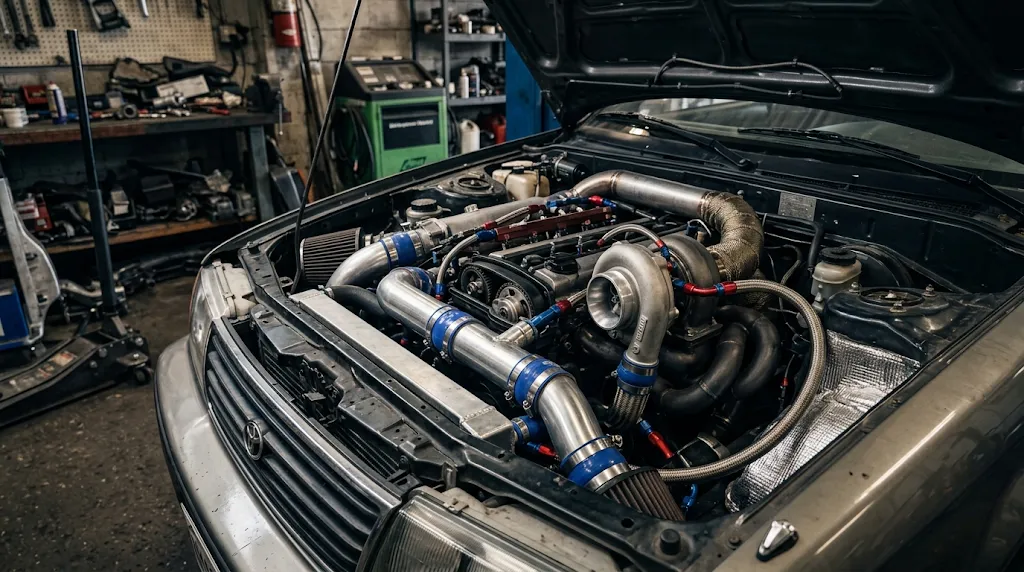
The exhaust side of a turbo kit operates in an environment of extreme thermal stress. The turbo manifold must support the physical weight of the turbocharger while cycling between ambient temperatures and 1,600 degrees Fahrenheit without cracking. Thick-walled tubular manifolds or quality cast-iron units are critical here.
From the turbine exit, the downpipe routes expanding gases down past the firewall and under the chassis. A minimum diameter of 2.5 to 3 inches is generally required to minimize backpressure; any restriction downstream of the turbine wheel reduces the pressure differential across the housing, slowing spool-up and trapping heat against the cylinder head.
Intake Plumbing: Intercoolers, Piping, and Blow-Off Valves
To counter the thermodynamic penalty of compression, pressurized air must pass through an air-to-air intercooler positioned in the front bumper, where ambient airflow pulls heat out through aluminum fins.
The charge pipes connecting the compressor to the intercooler, and subsequently to the throttle body, must be leak-free. A single loose silicone coupler will bleed off your boost and trigger chaotic fueling calculations.
Mounted along these charge pipes is the blow-off valve (BOV). When you are at wide-open throttle, the system is moving immense volumes of pressurized air. The instant you lift off the accelerator to shift, the throttle plate snaps shut. That pressurized column of air slams into a closed door, creating a high-pressure shockwave that reflects backward toward the spinning compressor wheel. The BOV senses the sudden intake vacuum behind the throttle plate, snaps open, and vents that trapped pressure to the atmosphere, protecting the turbo’s bearings from destructive axial thrust.
Lubrication and Cooling: Tapping for Oil and Water Lines
A turbocharger shaft spins atop a paper-thin wedge of pressurized oil within hydrodynamic sleeve bearings (or ceramic ball bearings). Oil is the literal lifeblood of the unit, acting as both a lubricant and the primary cooling mechanism for the center rotating housing.
Clean, high-pressure oil is typically tapped from an oil pressure sensor port on the engine block via high-grade braided stainless steel lines. More critical than the feed, however, is the drain. Turbochargers do not push oil out under pressure; the oil drains strictly by gravity, foaming into a frothy mix as it drops out of the center cartridge. The oil return line must drop vertically into the engine’s oil pan, well above the oil level line, with zero kinks, dips, or horizontal runs. If the return backs up, oil forces its way past the turbo’s internal dynamic piston-ring seals, blowing straight into the exhaust and intake tracts.
If your turbo is water-cooled, plumbing it into the engine’s cooling circuit adds a vital safety net. When you shut off a hot engine, the coolant inside the turbo’s center housing will thermosiphon naturally, pulling heat away from the bearings and preventing the oil from coking (baking into abrasive carbon deposits) on the stationary shaft.
The Make-or-Break Supporting Systems
The shiny turbo kit in the engine bay is only half the battle. The unseen supporting systems dictate whether the car actually runs or becomes an expensive garage ornament.
Feeding the Beast: Upgraded Injectors and Fuel Pumps
More air demands an equivalent increase in fuel to keep combustion temperatures controlled and ratios balanced. Your factory fuel system was designed with just enough headroom to support stock output plus a modest factory safety margin. Under boost, it is hopelessly outmatched.
You will need a high-flow in-tank fuel pump, along with fuel injectors scaled to meet your targeted horsepower. Running an engine lean (insufficient fuel for the incoming air) under boost acts like a cutting torch inside the cylinder. The excess oxygen superheats the combustion chamber, resulting in immediate detonation, melted spark plug electrodes, and burned exhaust valves. Fuel under boost is not merely combustible; it acts as a chemical in-cylinder coolant.
The Brain Behind the Boost: Engine Management and Standalone ECUs
You cannot trick a factory naturally aspirated engine control unit (ECU) into managing boost with rising-rate fuel pressure regulators and crude sensor-fooling boxes. Factory NA map sensors cannot read positive manifold pressure, they become completely blind the millisecond the manifold crosses 0 PSI into boost.
Modern forced induction requires a programmable engine management system, whether that is a re-flashed factory ECU utilizing a multi-bar MAP sensor, or a fully programmable standalone engine control unit. The ECU must be able to read positive pressure, calculate fuel mass based on boosted volumetric efficiency, and most importantly, retard ignition timing. As cylinder pressure goes up, fuel burns substantially faster; if you leave the aggressive ignition timing map of a naturally aspirated car intact while under boost, peak cylinder pressure will hit while the piston is still traveling upward, snapping the connecting rod in two.
Drivetrain Realities: Clutches, Axles, and Traction
If your engine suddenly produces 80 percent more torque than the engineers intended, the rest of the mechanical chain will expose its weakest link within a week.
A stock clutch will slip almost instantly in fourth gear under full boost, glazing the friction material and ending the fun. You must factor in an upgraded pressure plate and a clutch disc capable of holding the newfound torque without turning pedal modulation into an on-off switch. Beyond the clutch, prepare for broken motor mounts, axle shaft failures on hard launches, and the sudden reality that your open-differential transaxle now spins a single tire uselessly into smoke.
The First Start and Dyno Calibration
The mechanical assembly is complete. The plumbing is routed, the wiring harness is secured, and every fitting is torqued. The impulse to turn the key and immediately take the car around the block must be resisted. The final steps require absolute discipline.
Pre-Oiling, Leak Checks, and Basemap Verification
Never start a freshly turboed engine dry. Pull the fuel pump fuse or disconnect the ignition coils and crank the engine over in ten-second bursts until the oil pressure light on the dash extinguishes. This pre-oils the engine and fills the turbo’s center housing before it ever experiences exhaust heat or load.
Double-check every vacuum line with a hand pump. Look over fuel rails, injector O-rings, and oil fittings for the slightest drip. Load a proven basemap into your standalone ECU—one configured with your exact injector scale, sensor calibrations, and a deeply conservative ignition timing strategy. A basemap exists for exactly one purpose: to allow the car to start, idle, and drive gently onto a trailer or dyno. It is not for “testing” boost down your local backroad.
Tuning for Longevity: Timing, Knock Control, and Air-Fuel Ratios
The dyno is the ultimate arbiter of your build. Here, a professional calibrator works systematically to build safe, repeatable tables.
The tuner will watch three variables above all: air-fuel ratio (AFR), exhaust gas temperature (EGT), and knock sensor feedback. Under wide-open-throttle boost, AFRs on pump gas are typically driven rich often into the 11.2:1 to 11.8:1 range—to suppress heat. Ignition timing is pulled back conservatively, then advanced degree by degree while watching the dyno curve. As long as torque continues to rise with each degree of advance, the engine is happy; the moment torque gains plateau, timing is backed off to a safe, reliable window, long before physical knock or pinging occurs.
Living with a Turbocharged Project: Habits for Long-Term Reliability
Transforming your car with boost means your ownership experience changes permanently. You cannot treat a modified turbocharged car like a maintenance-free commuter.
Your oil change intervals must be cut in half. The intense heat of the turbo breaks down the viscosity of synthetic oils far faster than an NA application, and traces of fuel dilution are inevitable. Spark plugs must be gapped tighter often down around 0.022 to 0.028 inches to prevent the dense, high-pressure air-fuel mixture from blowing the spark out like a birthday candle.
Finally, practice thermal discipline. When you jump in the car, drive gently until the oil (not just the coolant) reaches full operating temperature before leaning into boost. More importantly, when you arrive at your destination after a hard drive, do not shut the engine off immediately. Let it idle for 60 to 90 seconds. This allows oil and coolant to continuously circulate through the glowing turbo housing while the turbine wheel spools down, gradually dissipating heat rather than letting stagnant oil bake into the journals.
Treat the hardware with respect, pay the tax for high-grade components and tuning up front, and your boosted project will reward you with explosive, addictive power every single time you sweep the needle toward redline.